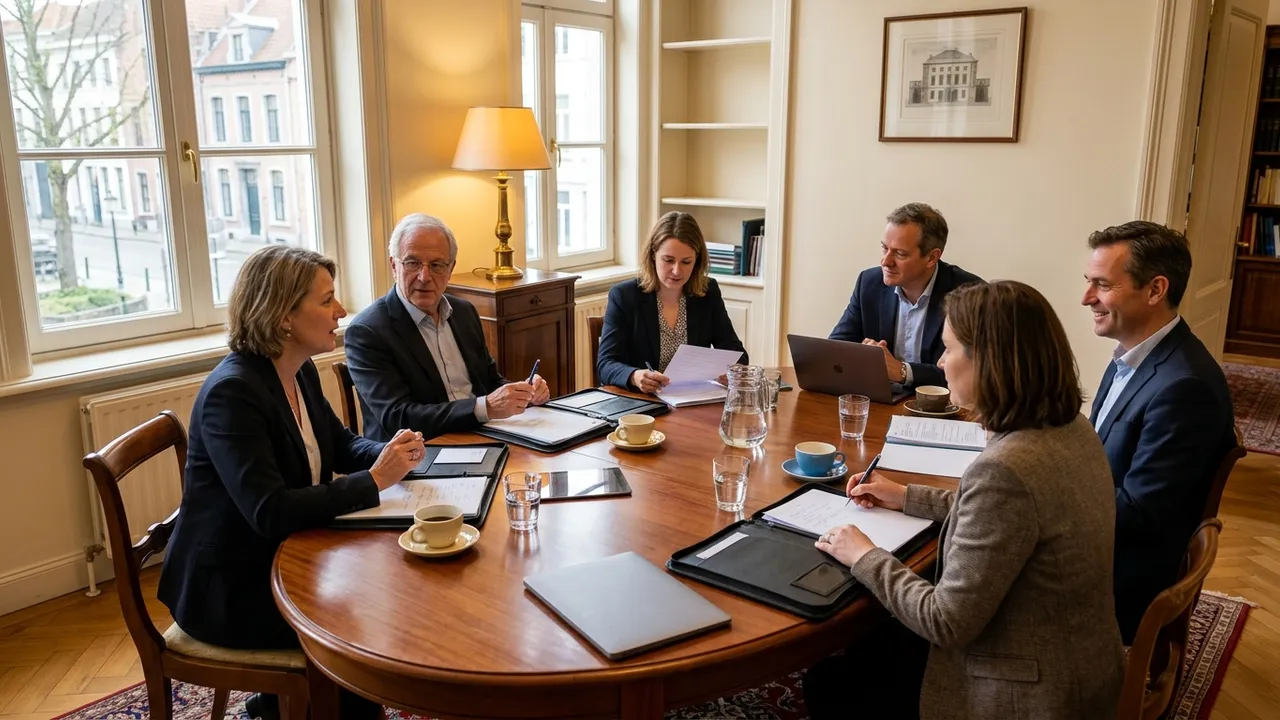
A fund coming in changes how decisions are made more than who owns the company. A director or observer on the board, regular reporting, a list of decisions to share and an exit horizon: these rules are written into the articles of association and the shareholders' agreement. They are negotiated before signing, not after.
My thesis is simple, and it irritates people in meetings: the percentage you sell is the least important part of the deal. A fund at 20% with an open-ended list of reserved matters weighs more than a fund at 35% sitting as an observer. I saw it from the owner's side of the table, as financial controller of a Hainaut SME when a provincial invest came into the capital. The percentage took up most of the discussions. The list of reserved matters came up at the end of the session.
What changes the day after closing?
Four things, all visible in the owner's diary before they show up in the accounts.
- A board of directors that actually meets, with an agenda, papers sent in advance and minutes.
- Regular reporting: monthly or quarterly figures, budget tracking, agreed indicators.
- Shared decisions: those the agreement reserves for the fund's consent.
- An exit horizon that will need discussing, even with an evergreen fund.
In the first month, reporting is what costs. A 40-person SME that produced its figures once a year for the annual accounts suddenly has to deliver a monthly table, compared with budget, with a comment on the variances. Someone has to do it. In the case I lived through, that was me, and in the first year that table took a real share of my month.
Well negotiated, these rules bring discipline and an outside view. Badly negotiated, they slow the company down. The difference is not in the percentage.
The objection: a minority holder has no power
The objection is serious, and it holds in pure company law. A 20% shareholder does not appoint directors alone, does not set the budget, does not decide on investments. The general meeting decides most day-to-day matters by simple majority. The owner at 80% stays in charge.
The Companies and Associations Code (CSA, the federal code governing Belgian companies) still sets one threshold that matters. Amendments to the articles require a three-quarters majority of the votes cast (art. 5:100 for the SRL, art. 7:153 for the SA). Above 25% of the votes, the fund can therefore block a capital increase, a change of corporate purpose or a conversion on its own. The text is available on ejustice.
Above all, the fund does not negotiate its power in the Code. It negotiates it in the agreement.
Where the minority holder wins power back
In three places in the shareholders' agreement, which I always read before the valuation clause.
The first is the board composition. The fund usually asks for the right to nominate one or more directors. The shareholders then undertake to vote for that candidate: this is a voting agreement, allowed under the CSA if it is limited in time and consistent with the company's interest (art. 5:46 SRL, art. 7:56 SA).
The second is the list of reserved matters. These require the fund's consent or a reinforced majority: annual budget, investments above a threshold, borrowing, asset disposals, executive pay, senior hires. A closed list of six items is workable. A list ending with "and any significant decision" hands over a general veto.
The third is the exit: expected timetable, tag along, drag along, buy-out procedure. The details are in the guide to exit clauses.
| Fund's lever | Source | What it allows | What you can negotiate |
|---|---|---|---|
| More than 25% of the votes | Art. 5:100 and 7:153 CSA | Block an amendment to the articles | Nothing: it is the law, unless you stay below 25% |
| Director's seat | Voting agreement (art. 5:46, 7:56) | Vote on every board decision | Non-voting observer, or a single seat |
| Reserved matters | Shareholders' agreement | Veto over a list of decisions | Closed list, figures for thresholds, duration |
| Reporting | Shareholders' agreement | Monthly or quarterly information | Frequency, content, delivery deadline |
| Drag along | Shareholders' agreement | Force a full sale | Threshold, floor price, delay |
| Fund's horizon | Fund's own articles | Timing pressure on the exit | Choose the fund accordingly |
In percentages: a fund at 20% that sits on the board with reserved matters covering budget and borrowing co-decides 100% of the decisions that shape the company's future. Its percentage only measures its share of the sale price.

Does the fund sit on the board?
Most often, yes. Namur Invest (the Namur provincial invest) says so in its answers to common questions: it generally asks for a director's seat or acts as an observer. The other players in my survey do not publish their policy on this point; it is not published, and it appears in the letter of intent.
The nuance lies in the difference between director and observer. A director votes, carries liability and receives every document. An observer attends and receives the documents but does not vote. For a first minority stake with a modest ticket, an observer is often enough for the fund. For a ticket close to its published ceiling, it will want a vote.
From the owner's side, a fund director is not an enemy on the board. The one I saw in action asked the questions the bank had stopped asking years before, about margin per customer and working capital needs. He also held back an investment that deserved it. I would not have said so at the time.
A fund on the cap table, region by region
The legal framework does not change: the CSA is federal, it applies in Wallonia, Brussels and Flanders alike. What changes is the type of player across the table, its preferred instrument and its horizon. Checked on the players' websites on 15.10.2026:
| Player | Area | Published ticket | Published instruments | Published horizon |
|---|---|---|---|---|
| ORSA (formerly Investsud) | Wallonia | €500,000 to €2,500,000 | Equity, quasi-equity, Smart Bond (5 to 10-year subordinated loan, no dilution) | No imposed exit horizon (evergreen) |
| Noshaq | Liège province | Not published | Equity stakes, loans, leasing depending on group entity | Not published |
| Namur Invest | Namur province | €100,000 to €2.5M in general | Equity, convertible, subordinated, unsecured, secured and bullet loans, property leasing | Not published |
| Invest.BW | Walloon Brabant | Up to €2.5M in total | Equity, subordinated or mezzanine loan, convertible | Typically 5 to 10 years |
| finance&invest.brussels | Brussels-Capital Region | Up to €5M for SMEs, alongside other investors | Loans, guarantees, equity stakes | Not published |
| Theodorus | Belgium | €250,000 initial investment, up to €2.5M | Equity, seed and early stage | Closed-end funds of 12 to 14 years (II and III); Theodorus I evergreen |
Two readings of this table. First, the instrument: Namur Invest publishes a portfolio split roughly 20% equity and 80% debt, and ORSA highlights a subordinated loan with no dilution. Some owners who think "fund on the cap table" will end up with a loan and no outside director. Second, scale: Noshaq (the Liège provincial invest) reports €120M of investments approved per year on average over the last five years, and 60 staff. That is a measure of scale, not of method: its reporting requirements are not published.
In Flanders, the public tool is PMV. Its governance terms are not part of my survey, and I do not comment on them. To compare the nine Walloon and Brussels players on the same criteria, the ranking of SME funds reproduces the full survey.
How does the fund exit?
Through one of three doors: buy-back by the owner, resale to another investor, sale of the whole company to an acquirer. The agreement should say which one is expected, and at what price or by which method.
The fund's horizon sets the pressure. A closed-end fund must return money to its investors before a date set when it was created. If your company is not ready by then, it will still organise its exit, sometimes by triggering a drag along. An evergreen fund has no hard deadline. It will exit too, but at a time chosen with you. The guide on evergreen vs closed-end funds explains what that changes.
The most common case for a family SME is a buy-back by the owner or a successor. The agreement must then fix the exit valuation method at signing. Otherwise the price discussion happens when the fund needs to sell and you need to buy, which is exactly when nobody is in a position to negotiate calmly.
One remark I rarely hear in meetings: the exit is prepared on entry. An owner who wants to buy back the fund's shares in seven years needs to know today how that buy-back will be financed.
The nuance: when fund governance really helps
I am not claiming that a fund on the cap table is a constraint to minimise. The thesis is about how to read the deal, not about whether to sign one.
Fund governance serves the company in three cases I have seen up close: an SME that had never had a formal budget and needed one to talk to its bank, a handover where the seller had to let go gradually, and a growth phase where the owner could no longer decide everything alone. In all three, the board was a tool.
It works against the company when the list of reserved matters is open-ended, when the reporting is modelled on a listed company's, or when the fund's horizon does not match the project.
The rules are negotiated once, before signing. After that, you live with them for five to ten years. Have a lawyer review the agreement and your accountant review the reporting plan before closing.
Comparator
Compare investment funds side by side.
Compare now →
Frequently asked questions

From 2009 to 2017, Cédric spent eight years in the corporate lending department of a Belgian bank in Namur, on the side that turns files down and writes the covenants. He then became financial controller at an industrial SME in Hainaut just as a provincial invest took a stake in its capital. Based in Gembloux, he rereads the terms published by Walloon and Brussels funds and invests every month.